The Burg Desk · 2026-08-12
The Shadow Crossed the World
It started over Siberia this morning and it ends on a lawn in Fredericksburg tonight. One Moon, one day, working the whole planet — and The Burg gets the last shift.
years since Reykjavik last stood in the Moon's shadow — until today
The year's only totality. At mid-afternoon our time, the Moon slid squarely in front of the Sun and dragged a shadow about 180 miles wide across the top of the world — Siberia, then eastern Greenland, then Iceland, then down to northern Spain. It was the first total eclipse to touch continental Europe since 1999. Spain hadn't seen one since 1905. Iceland since 1954.
This is what it looked like from orbit. That darkness swallowing the North Atlantic is the Moon's shadow lying on the Earth — Greenland's coast still lit at its edge, Iberia at the rim, and a tropical storm named Cristobal spinning in the corner of the frame like a bystander. A weather satellite caught the whole thing at 18:10 universal time. Image: Meteosat-12, EUMETSAT.
Iceland got clouds — and chills anyway. On the Snæfellsnes Peninsula the sky stayed stubborn and hid the corona. It didn't matter as much as you'd think. Observers watched the shadow arrive from the north — "like this big ominous encroaching darkness," as Astronomy magazine's editor on the scene put it. The temperature fell roughly six degrees Celsius in minutes. People could suddenly see their breath in August. And around the whole horizon, in every direction at once, burned a 360-degree sunset while overhead went black. Twenty thousand visitors flew to an island of under four hundred thousand people for those two minutes. The sky charged full price with the curtain down.
Spain won the day. León and the Castilian plain sat under clear sun as totality arrived at 2:29 p.m. our time and finished by 2:31. This frame — the Moon taking its bite — was made at San Millán de los Caballeros, in the amber a low Spanish sun does better than anywhere. Photo: NASA/Bill Ingalls.
And it ends here. An eclipse can only happen at new Moon — which means tonight, over Fredericksburg, there is no Moon at all. Tonight is also the peak of the Perseid meteor shower. The same Moon that stole the Sun over Spain this afternoon now steps out of the way so The Burg can watch thousand-year-old comet dust burn overhead. One day. Two shows. The finale plays in your backyard, and admission is a lawn chair.
The shadow crossed Greenland, Iceland and Spain. The afterparty is over Spotsylvania County.
The Burg Desk
The rest of the ledger
The partial eclipse reached far beyond the narrow shadow — most of Europe, Canada, northwest Africa and a slice of the U.S. saw the Moon take at least a nibble. From Slovakia, half a continent from totality, the Sun spent the evening as an orange crescent:
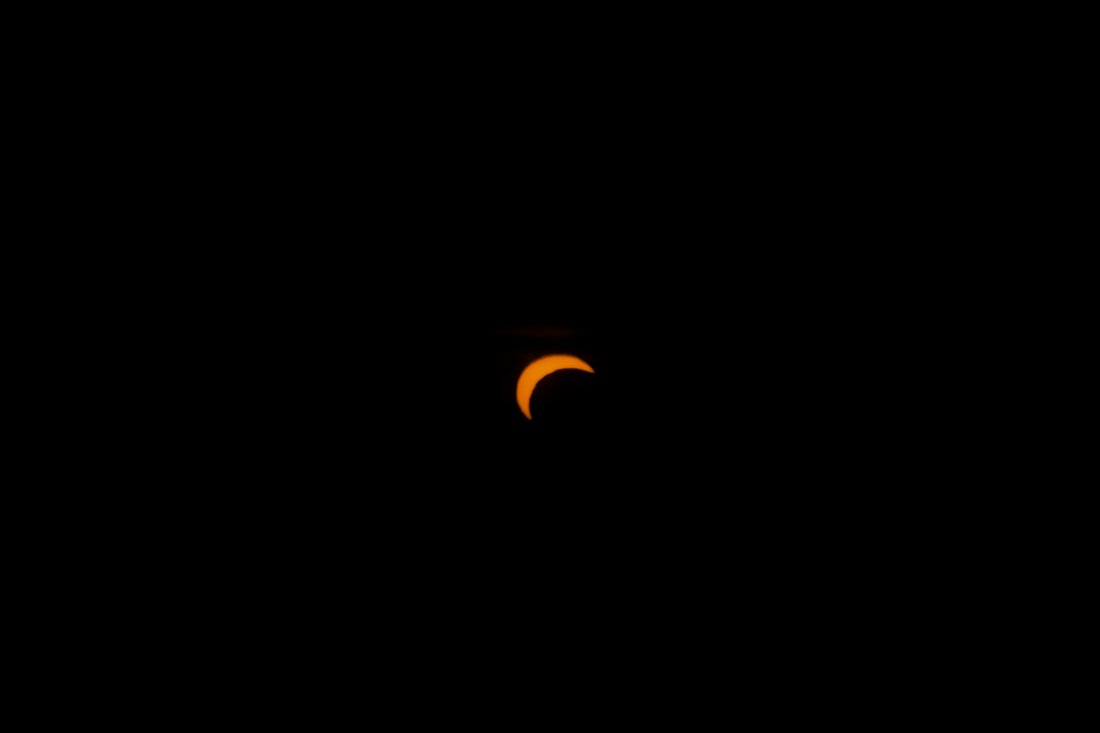
Partial eclipse from Martinské hole, Slovakia — photo by milan12332567, CC BY-SA 4.0, via Wikimedia Commons.
One more for the connoisseurs: during the partial phases, observers in Maine caught the International Space Station crossing the face of the Sun — a silhouette moving at five miles per second through an eclipse in progress.
Sourcing, stated plainly: path, times and history from NASA and CBS News; ground reports from Astronomy magazine's live desk in Iceland and Spain; broadcast record via PBS NewsHour. Satellite image by EUMETSAT (Meteosat-12, attribution license); Spain photograph NASA/Bill Ingalls; Slovakia photograph CC BY-SA 4.0 via Wikimedia Commons.
Bottom line
The world watched the Moon work its day shift. The night shift belongs to us: gaps in the clouds after midnight, best between 2 and 5 a.m., looking northeast from anywhere dark. The desk's full viewing guide from this morning still stands. Catch a good one and send a tip — the desk collects falling stars, and tonight the whole sky is shedding.